Study of massive early galaxy cluster El Gordo points to dark matter that interacts with itself
Simulations of the colliding cluster fit a two-state self-interacting dark matter model best, Universe Today reported, though uncertain measurements leave the result open.
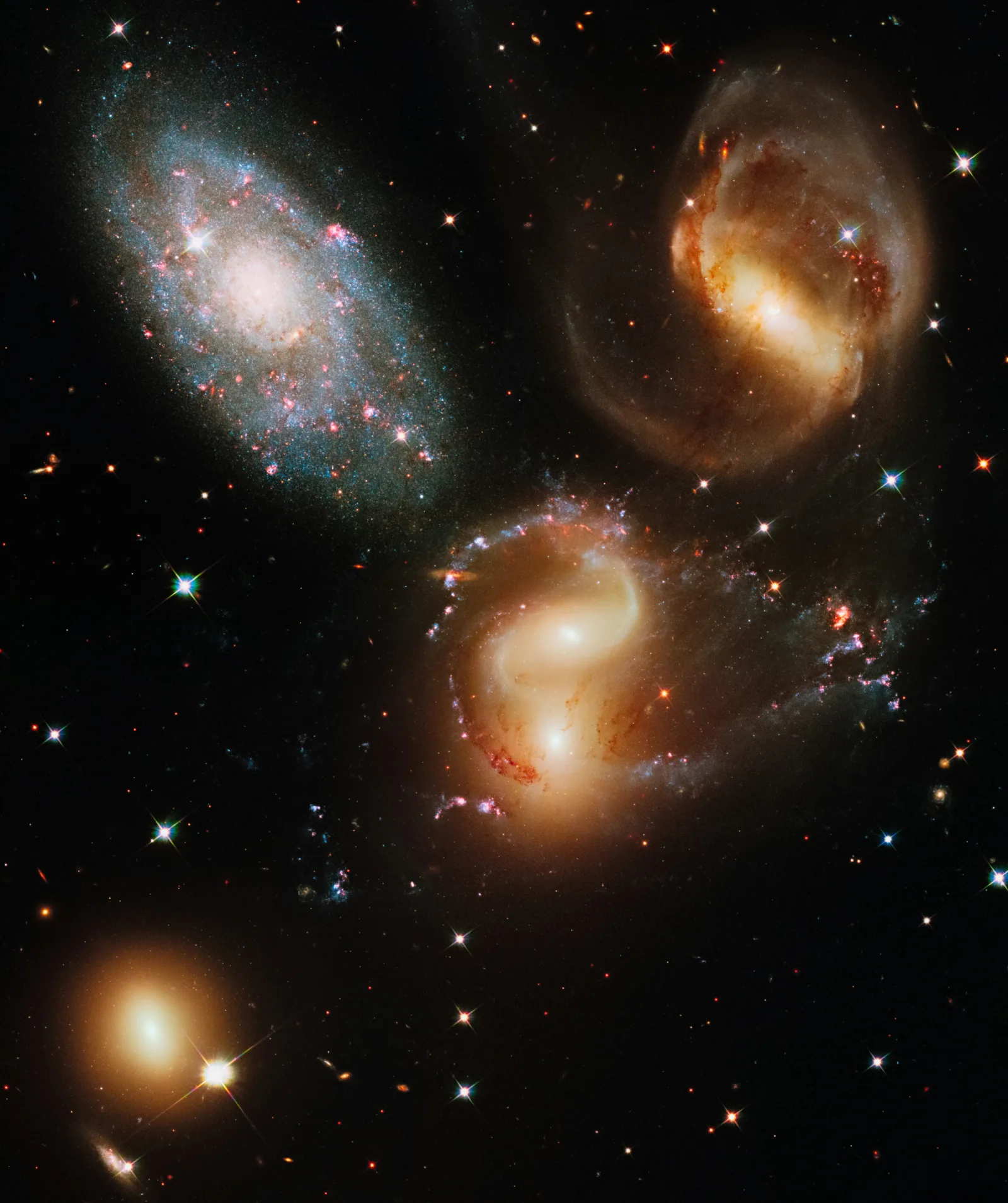
A new study suggests that dark matter may collide with itself in a way that lets it clump together and cool down at the same time. The researcher tested the idea against a huge, distant galaxy cluster known as El Gordo, according to Universe Today.
The study, by R. Valdarnini, was published in The Astrophysical Journal. It used N-body simulations of El Gordo's two colliding regions. Universe Today reported that a model with two states of dark matter, allowing both elastic and inelastic collisions, was the best fit to what astronomers observe. It fit better than models where dark matter does not interact at all and models where its collisions are only elastic.
El Gordo, nicknamed the Fat One, sits seven billion light-years from Earth. According to Universe Today, its two colliding regions have a combined mass of more than two quadrillion solar masses. That is extraordinarily large for such an early period of the universe. Some astronomers treat it as a counter-example to the standard model of cosmology, because it is hard to explain how cold dark matter could build such a large structure so quickly.
The question matters because dark matter makes up most of the mass in the cosmos, yet it barely interacts with light or ordinary matter. Whether it interacts with itself is still an open question. The most popular view is that it does not, Universe Today reported, because observations show dark matter is mostly cold. If its particles bounced off each other the way ordinary gas molecules do, they would stay warm.
The new model tries to get around that problem. In it, dark matter has a ground state and an excited state. Most collisions are elastic. But with the right energy, a collision can push a particle into the excited state, taking kinetic energy out of the collision. That would let dark matter gather into clusters while cooling. Universe Today noted that earlier models of self-interacting dark matter that relied only on elastic collisions have had mixed results.
There is a major caveat. Astronomers are still quite uncertain about El Gordo's exact mass and how fast its two regions are colliding. According to Universe Today, if the cluster sits at the low end of the estimated range, the two-state model would not fit the data.
“So this is a possible solution, not a definite one.”Brian Koberlein, astrophysicist, writing in Universe Today
Koberlein added that until dark matter particles are directly observed, many possibilities remain open.