Radio observations add to evidence that Betelgeuse has a close companion star
A study using the VLA and ALMA found Betelgeuse's atmosphere turns egg-shaped on a cycle, The companion still has not been confirmed.
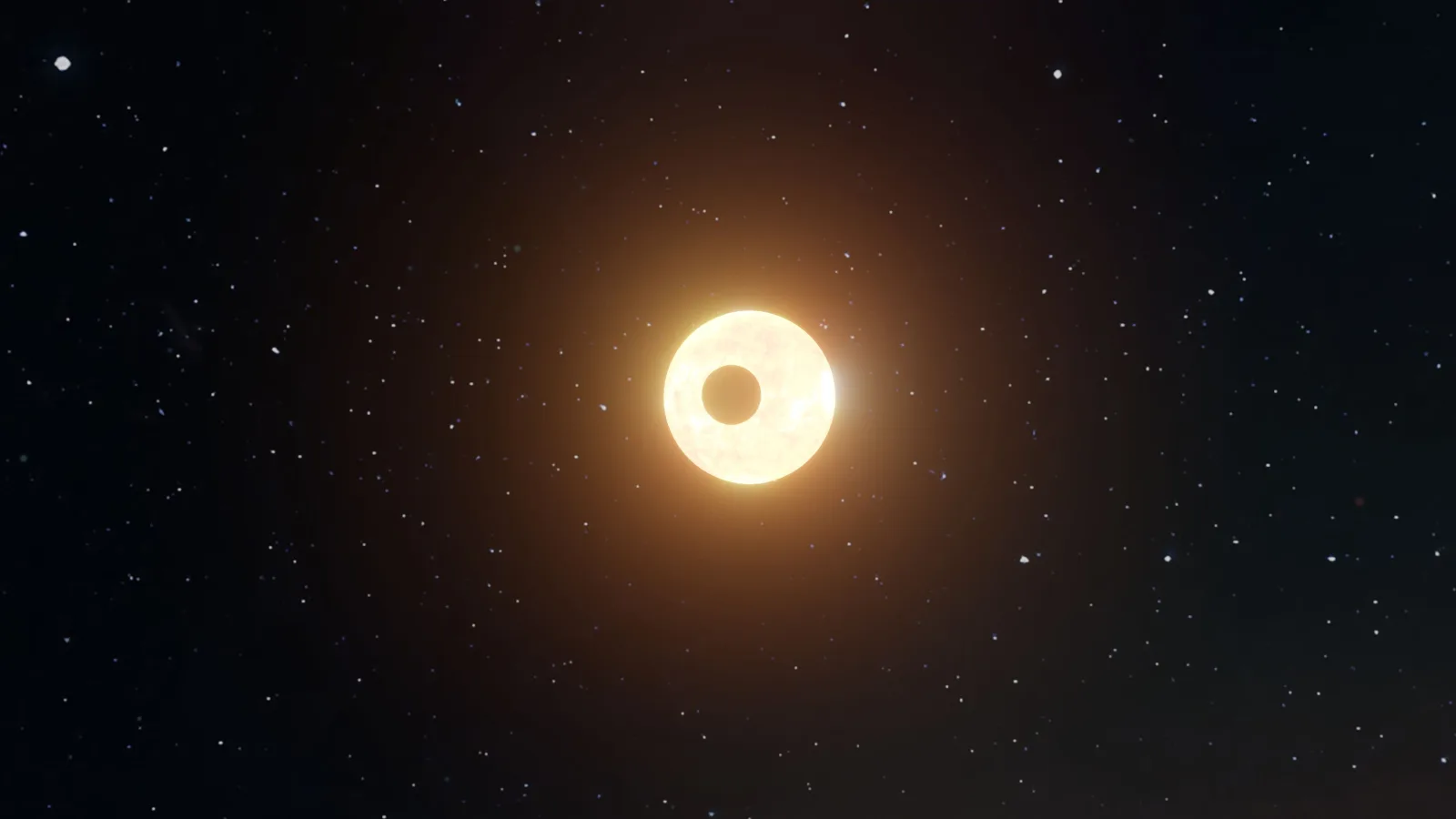
New radio observations suggest that a companion star is pushing the atmosphere of Betelgeuse out of shape, according to Universe Today. Betelgeuse is the red supergiant that marks the shoulder of Orion.
The study, by L. D. Matthews and colleagues and published in The Astronomical Journal, used the Very Large Array (VLA) and the Atacama Large Millimeter-submillimeter Array (ALMA). Universe Today reported that both instruments can spatially resolve Betelgeuse at radio wavelengths. The team found that the star's atmosphere is somewhat egg-shaped at times. It cycles between looking more circular and more elongated, which is what you would expect if a companion mass were distorting it.
The proposed companion is a young yellow star named Siwarha that has not quite reached the main sequence. It cannot be observed directly, and there has been debate over whether it exists at all, the outlet reported.
The finding matters because of how Betelgeuse is built. Universe Today said the star is near the end of its life and has swollen up. Its mass is only 14 times the Sun's, but its diameter is more than 640 times the Sun's. Counting its atmosphere, it is wider than the orbit of Mars. Its outer regions are extremely thin. Siwarha is thought to orbit at less than three times Betelgeuse's radius, well inside that outer atmosphere, so it would stir the atmosphere as it moves.
The result could also explain a pattern in the star's brightness. Betelgeuse has long been known to vary on a cycle of about 425 days, and a second pattern of about 5.9 years has also been found. According to Universe Today, the longer cycle lines up with the egg-shaped distortion and with the possible orbital period of Siwarha.
Universe Today called the study "the strongest evidence so far that Betelgeuse is a binary star." The outlet said it also shows the star's behaviour is more complex than had been thought. If the companion is stirring the atmosphere, then the brightness and temperature changes astronomers see do not come from Betelgeuse alone.
Some questions remain open. The same article says the evidence is not strong enough to confirm that Siwarha exists. The companion has still not been seen directly, and the new result is described as consistent with earlier studies that suggested it was there, not as proof. Universe Today does not say how or when the companion's existence might be confirmed.
This story is based on one report, from Universe Today.